Icosmo Katakamuna
The Utahi in Their True Pitch
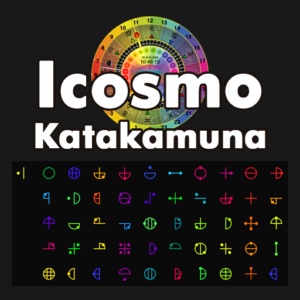
Icosmo Katakamuna sings the 80 Utahi of Katakamuna, the ancient Japanese songs written in spirals of circles and lines. Each of the Katakamuna symbols carries a colour, given as a CMYK value in an original Japanese book source. Icosmo translates every colour into its light wavelength and brings that wavelength down through the Cosmic Octave into the audible range. For the first time, every symbol has its own exact pitch and key.
A male and a female voice chant each Utah in the way a Katakamuna practitioner performs it: an even pulse of syllables, long breath phrases, held and fading phrase ends – with every syllable sung on its Icosmo pitch. A spectral synth tone can play along, and the Icosmo Mixer lets you blend synth, male and female voice.
How to Use It
- Press Start Katakamuna once the voices are loaded, choose an Utah and press play.
- S, M and F switch the synth tone, the male and the female voice on and off; with M and F together both voices sing in harmony.
- The faders mix synth, male and female voice and set the master volume; the spectrum above shows every sounding tone in the colour of its key.
- Loop repeats the Utah, the continuous button plays one Utah after the other. The tempo is free: 120 BPM is the natural pace (one syllable per eighth note), 60 BPM a calm, meditative one.
- The Utah disc and the Amatsu Harmonic Grid light up every symbol while it sounds. Click any symbol of the grid to hear it sung on its own.
The Saga of Katakamuna
In the winter of 1949, the Japanese physicist Narasaki Satsuki was measuring the electricity of the ground on Mount Kanagi, in the Rokkō mountains above Kobe. During his work in the forest he met a hunter named Hiratōji, who told him that his father had been the guardian of the Katakamuna shrine and that he kept an old scroll from it, which no one was ever allowed to see. Moved by Narasaki’s work, the hunter brought the scroll and let him copy it.
The scroll showed no familiar writing. It was filled with symbols made of circles and straight lines, arranged in spirals that turn towards a centre. Narasaki spent years deciphering them. He found that each symbol stands for one sound of the Japanese language, and that all of them are drawn from one figure: the Yata-no-Kagami, the sacred mirror – a circle crossed by a cross, with small circles at its points. The spirals turned out to be 80 songs, the Utahi.
The Utahi speak of the creation of the world and of the forces that shape all life. They name two realms: Amana, the visible world of form, and Kamuna, the invisible source from which everything emerges and to which everything returns. Between them resonate the sounds themselves – the Kototama, the spirit within sound. The first Utah begins with the words Katakamuna Hibiki Manosubeshi: the resonance of Katakamuna that brings order to all things.
From this Narasaki developed a teaching he called Sōjishō-gaku, the science of similar forms: the idea that the same patterns repeat from the smallest particle to the cosmos. After his death in 1974, his student Uno Tamie carried the research forward and published it for many years.
According to the tradition, the Katakamuna culture is far older than any written history of Japan – a civilisation of an intuitive science that understood nature through resonance. Historians have not confirmed this age, and the origin of the scroll remains a mystery. What remains is a complete system of sounds, symbols and colours – and in it, the pitches that Icosmo now lets you hear.