Icosmo Cymatics

Watch the Tones Take Shape
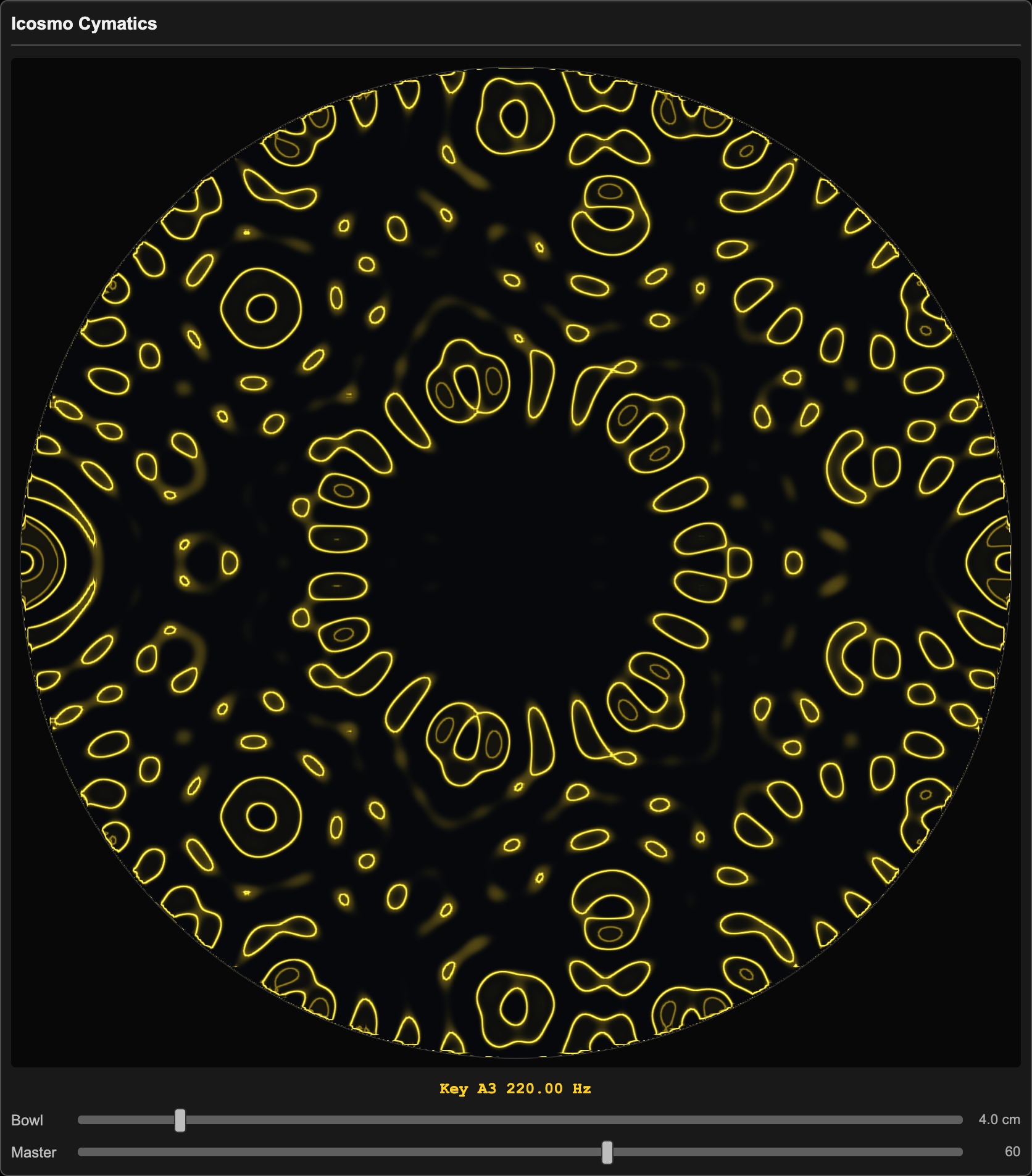
Icosmo Cymatics makes the tones of the Icosmo Matrix visible in a virtual bowl of water. A small bowl stands on a loudspeaker, the tones shake it from below, and the water answers with standing waves: rings, petals, lattices and swirling cells, lit from above by a ring lamp, just like the photographs of real cymatics experiments.
Listen to the living clock of the Icosmo Mixer — the tones of the hour, the minute and the second and the heartbeat — play any of the twelve keys in any octave, or calculate the Cosmic Octave of a planet, a moon or any frequency, and watch how the water shapes each tone in its own colour.
How to use:
- Click one of the twelve Keys to hear it and to see its pattern in the water. Click it again to stop it.
- Choose the Octave from 1 to 4. Every octave gives the key a new pattern: low tones draw large, calm waves, high tones fine and dense ones.
- Move the Key fader to change how strongly the tone shakes the bowl, and find the sweet spot where the most beautiful pattern appears.
- Raise the faders of the Icosmo Mixer to let the hour, the minute and the second sound, and add the Heartbeat.
- Choose a planet, a moon or a frequency in the Icosmo Calculator. Its tone plays at once, in its own tuning.
- Change the size of the Bowl from 3 to 12 cm, and set the loudness with Master.
Note: The water is calculated live on the graphics card of your device; nothing is sent to a server. Icosmo Cymatics needs a current browser with WebGL2. Click anywhere in the player to allow your browser to play sound.
Decoding the Water
Every part of Icosmo Cymatics shows one side of the tones and their place in the Icosmo Matrix. Here is what each part does:
The Water Bowl:
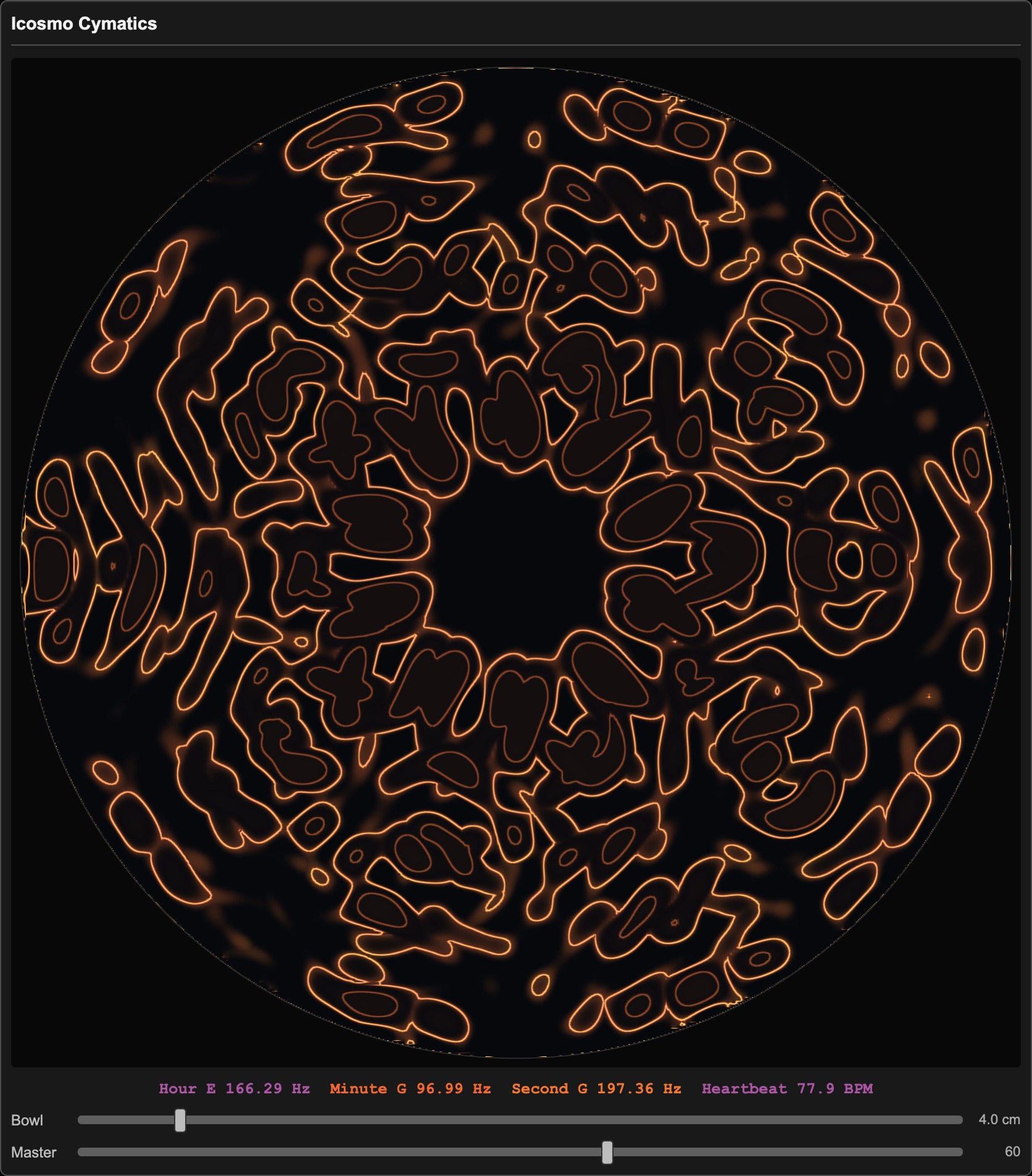
The bowl is filled 1 cm deep with water. The tones shake it, and the water answers at half their frequency (Faraday waves). Waves run inward from the shaken wall, meet in the middle as rings, are reflected by the wall and cross each other; older waves fade while fresh ones keep coming. Where they meet in the right rhythm, a standing pattern appears.
- The loudness shapes the pattern. A soft tone only sends weak rings from the wall. From about 40 % of the fader, the standing waves of the bowl grow out of the water and form petals and lattices. Loud tones make the pattern dense and restless, and several tones together weave it into one figure.
- The light draws the lines. A ring lamp above the bowl is mirrored by the water only where the surface has one exact tilt. There the water shows a thin glowing line. The stronger the waves, the more the lines move and multiply.
- Every line has the colour of its tone, derived from its frequency exactly as the Icosmo Calculator does it. Where several tones meet, the line takes the colour of the tone that shapes the water most.
- The size of the bowl changes which waves fit into it. The same tone draws a different figure in a 4 cm bowl than in a 10 cm bowl.
The water bowl is a physical simulation of waves on water. Real experiments also depend on the material and shape of the bowl, the temperature and the purity of the water.
The Icosmo Matrix Clock:
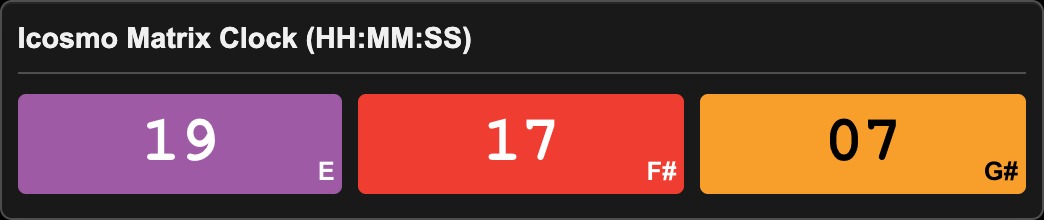
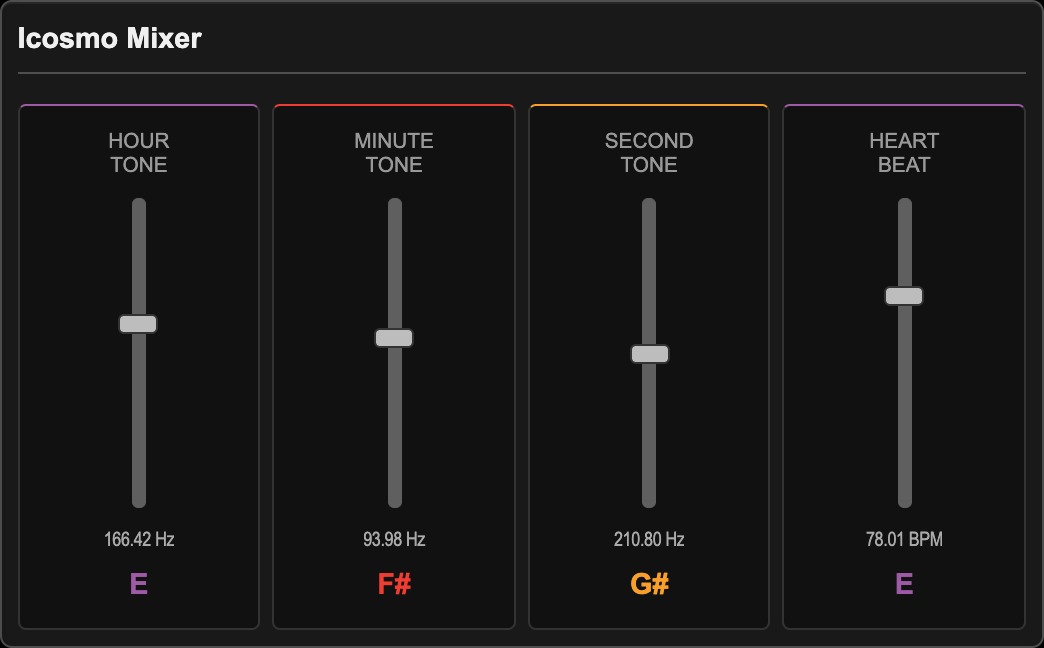
The clock shows the time of your device as hours, minutes and seconds, each in the colour and key of the Icosmo Matrix. The hour follows the 24-hour cycle of the Matrix; the minute and the second run through the same cycle of 24 steps, the minute every 2.5 minutes, the second every 2.5 seconds.
The Icosmo Mixer:
The same living clock as in the Icosmo Matrix Synth. Each fader lets one tone of the present moment sound and shake the water, and shows its frequency and its key in its Matrix colour:
- Hour Tone — the key of the hour. During the day its tuning rises slowly from 430 to 450 Hz within the hour, at night it falls back.
- Minute Tone — the minute cycle, a new step every 2.5 minutes.
- Second Tone — the second cycle, a new step every 2.5 seconds, one octave above.
- Heartbeat — a double beat on the hour tone, with a tempo derived from its frequency. Every beat knocks the bowl and sends rings of waves through the water.
Keys, Octaves and Tuning:
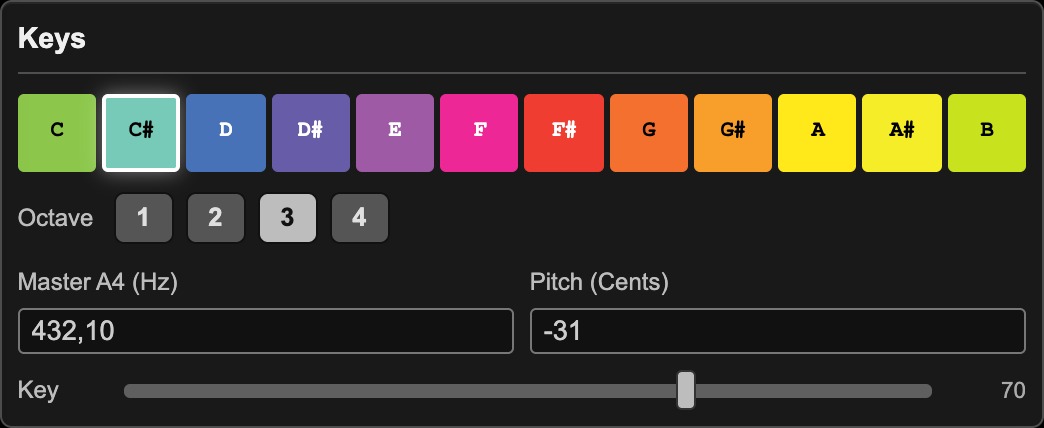
The twelve keys appear in their Icosmo Matrix colours. Click a key to let it sound as a pure tone, choose its octave from 1 to 4, and set its strength with the Key fader.
Master A4 sets the tuning of all keys, and Pitch (Cents) shows the same tuning as its distance from 440 Hz; change one and the other follows. The Icosmo Calculator sets both for you, so that its tone becomes an exact key.
The Icosmo Calculator:
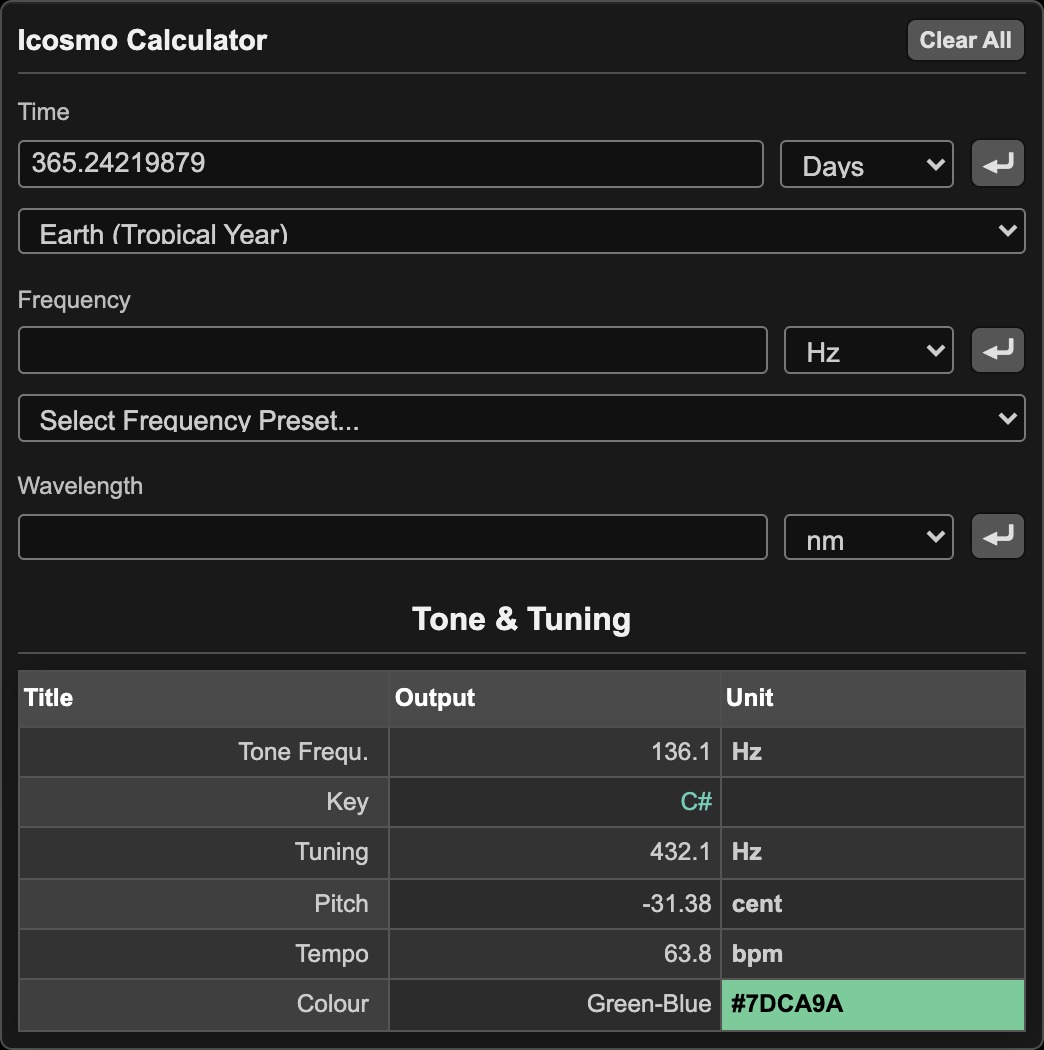
Enter a time period, a frequency or a wavelength, or choose one of the presets — the orbits of the planets, the moons of Jupiter, Saturn, Uranus and Neptune, the cycles of the Earth and the Moon, the Schumann resonance, the Solfeggio frequencies and more. The calculator lifts it by octaves into the audible range, the Cosmic Octave, and shows its tone frequency, key, tuning, pitch, tempo and colour.
The tone plays at once in the water: the master tuning and the key are set so that the key sounds exactly at the calculated frequency. The year of the Earth, for example, becomes 136.10 Hz, the key C# in a tuning of 432.10 Hz, and draws its pattern in green-blue.
Sound Made Visible
Cymatics, from the Greek kyma, the wave, is the study of visible sound. Its pioneers were Ernst Chladni, who made metal plates sing under a violin bow, and Hans Jenny, who gave the field its name. Alexander Lauterwasser and Michael Memminger photograph how water answers to tones and music, and Memminger also to the tones of the planets.
Icosmo Cymatics follows their experiments in a virtual bowl and connects them with the Icosmo Matrix: every frequency keeps its original value, lifted by octaves exactly as the Icosmo Calculator does it, and appears in the key and the colour the Matrix gives it.