Cosmic Octave Calculator
One Calculation for Time, Sound and Light
The Cosmic Octave Calculator translates any period, frequency or wavelength into a tone, a tuning, a tempo, a colour and the octave analogues in the brainwave bands. It is based on the octave principle that the Swiss mathematician Hans Cousto described in Die Kosmische Oktave (1984): doubling or halving a frequency does not change its tone, so any periodic phenomenon can be brought into the audible range – and into the range of visible light – without losing its identity.
The same calculation runs in every Icosmo tool. It is how the Icosmo Matrix gives a planet, a molecule and an hour of the day a common language.
How the Calculation Works – the Earth Year as Example
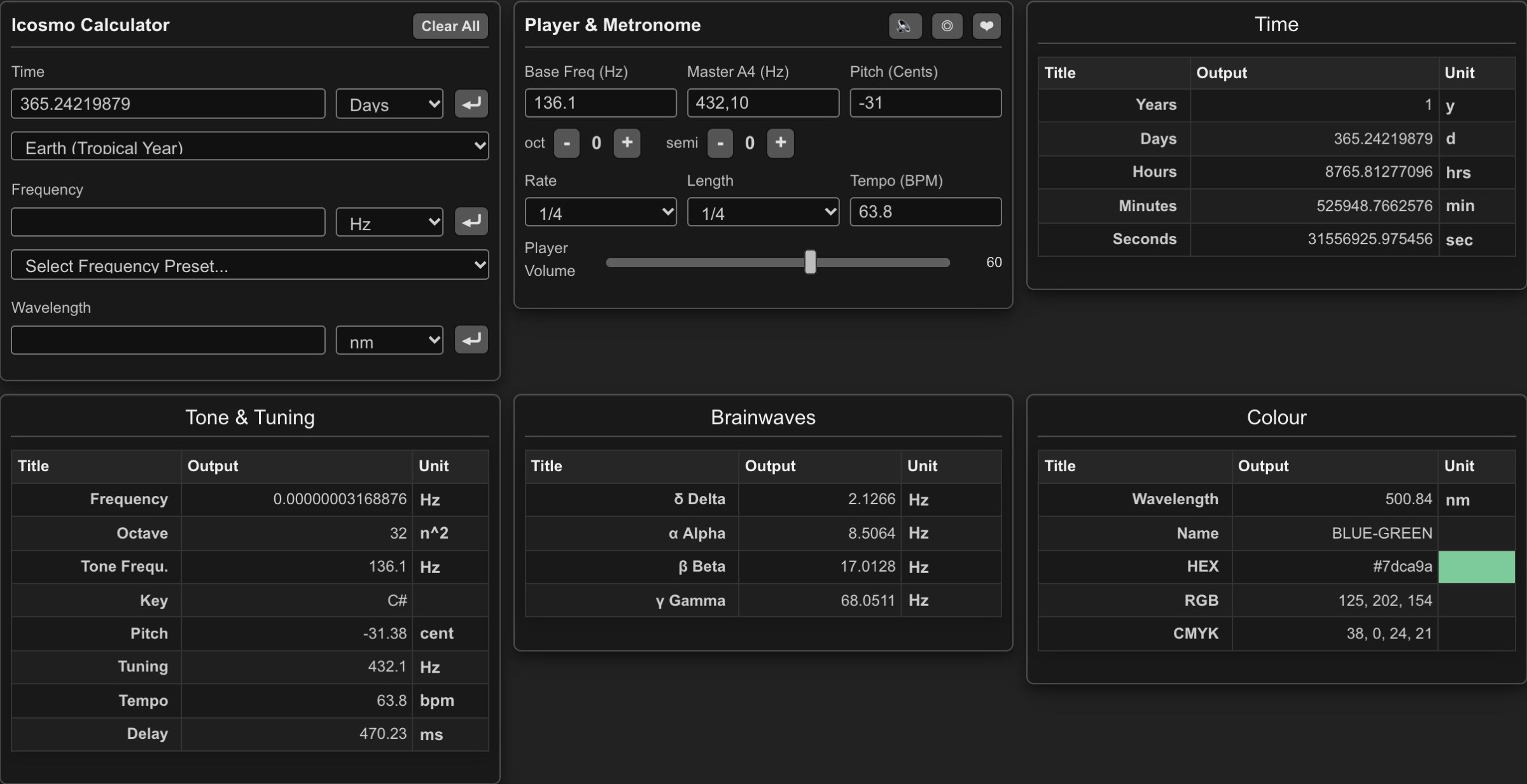
- Base value: the tropical year of the Earth, 365.24219879 days, is 31,556,925.98 seconds.
- Frequency: one cycle per year is f = 1 / 31,556,925.98 s = 0.0000000317 Hz.
- Octaving: doubled 32 times, this frequency reaches the audible range: 136.1 Hz.
- Tone and tuning: 136.1 Hz is the key C#, 31.38 cents below C# in the standard tuning A4 = 440 Hz. The tuning in which the Earth year is an exact C# is A4 = 432.1 Hz.
- Tempo: the tone folded into 127.09–254.19 Hz and multiplied by 60 / 128 gives 63.8 BPM; the matching eighth-note delay is 470.23 ms.
- Colour: raised by a further 42 octaves, the tone reaches the frequency of visible light: 500.84 nm, Blue-Green.
Input
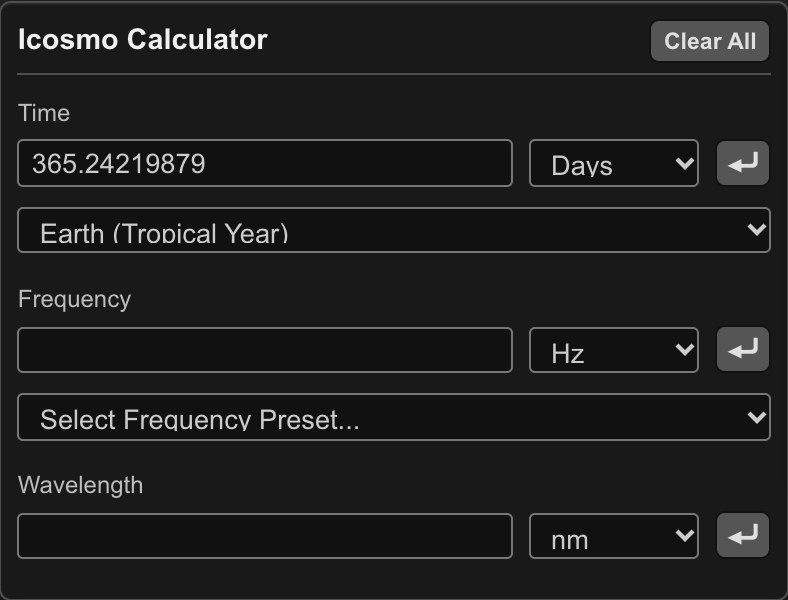
Enter one of three values and press ⏎:
- Time – any period in years, days, hours, minutes or seconds. The presets contain the rotation of the Sun, the orbits of the planets, the tropical year of the Earth, the cycles of the Moon and the orbits of major moons.
- Frequency – any frequency from Hz to THz. The presets contain frequencies that are often cited, such as the Schumann resonance (7.83 Hz), 432 Hz and the Solfeggio series, so they can be compared on the same scale.
- Wavelength – any length from nanometres to kilometres, for example the wavelength of a colour or of a radio signal.
Clear All resets the calculator.
Player and Metronome
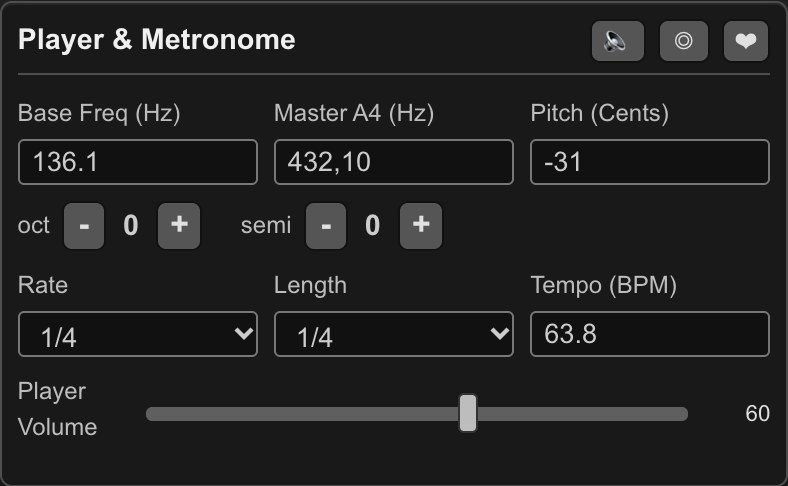
The calculated tone loads into the player at once:
- Base Freq, Master A4 and Pitch show the tone, its tuning and its deviation in cents.
- oct and semi move the tone by octaves and semitones.
- The three buttons at the top switch the tone, the metronome and the heartbeat on and off.
- Rate, Length and Tempo set the metronome; the tempo comes from the calculation.
- Player Volume sets the volume.
The Results
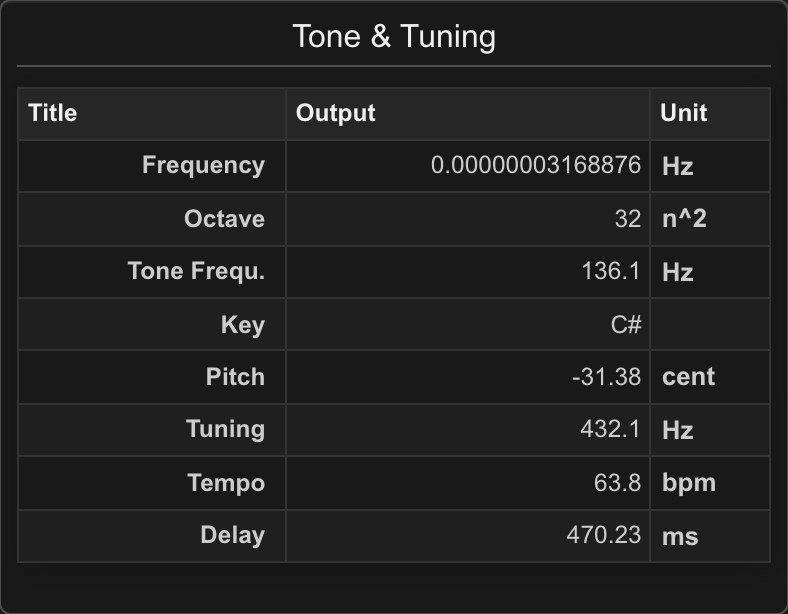
Tone & Tuning:
- Frequency – the frequency of the input value.
- Octave – the number of octaves to the audible range.
- Tone Frequ. – the tone in the audible range.
- Key and Pitch – the nearest key and the deviation in cents from the standard tuning A4 = 440 Hz.
- Tuning – the A4 in which the tone is an exact key.
- Tempo and Delay – the tempo in beats per minute and the matching delay time.
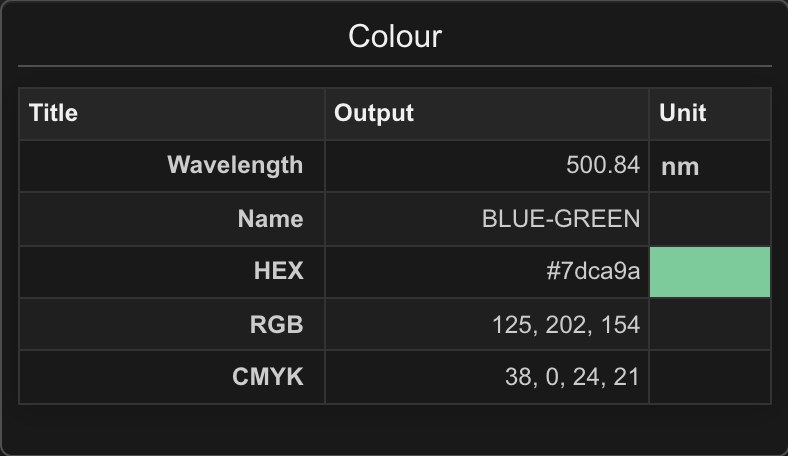
Colour:
The tone raised into the range of visible light (380–780 nm), with its wavelength, its colour name and the colour codes HEX, RGB and CMYK. The colour follows the twelve colours of the Icosmo Matrix and is blended towards the neighbouring colour by the deviation in cents.
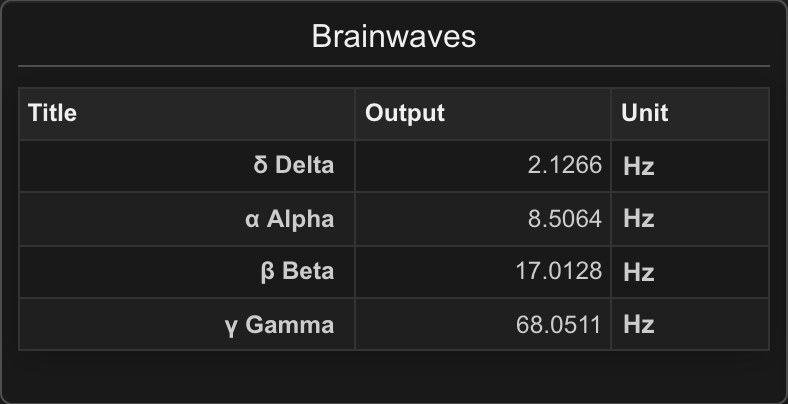
Brainwaves:
The tone octaved down into the frequency bands of the EEG: Delta (0.5–4 Hz), Alpha (8–12 Hz), Beta (12–30 Hz) and Gamma (30–100 Hz). For the Earth year: 2.13 Hz, 8.51 Hz, 17.01 Hz and 68.05 Hz. The values are octave analogues of the tone; they make no claim about an effect on the brain.
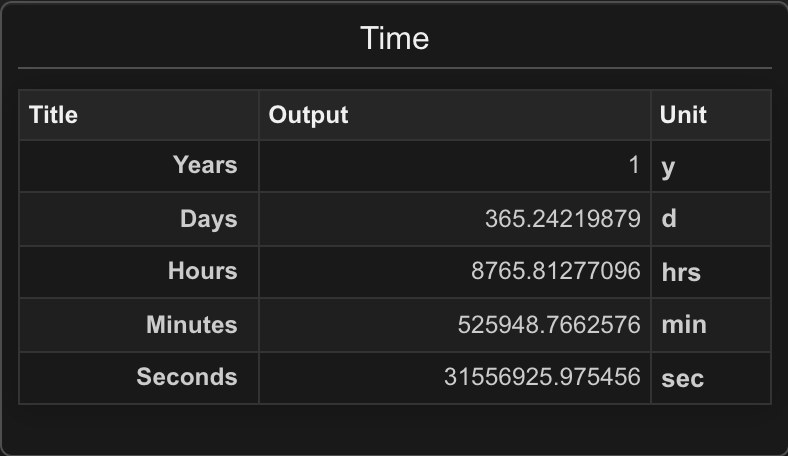
Time:
The period of the input value in years, days, hours, minutes and seconds.
Scope
The calculator works with the octave equivalence of music: tones an octave apart share their name and their pitch class. The translation into light is the same octave principle applied to the frequency of light; the colour codes are approximations for screen and print. Frequencies such as 432 Hz, the Solfeggio series and the Schumann resonance are available as presets for comparison; claims about their therapeutic effects are not scientifically established. More on the history of the Cosmic Octave: planetware.de.
The Cosmic Octave Calculator is also available as an app for macOS.
Created by Konstantin Jagoulis on 1 March 2024 in Crete.
Updated on 22 October 2026.