Icosmo Clock – Sky View
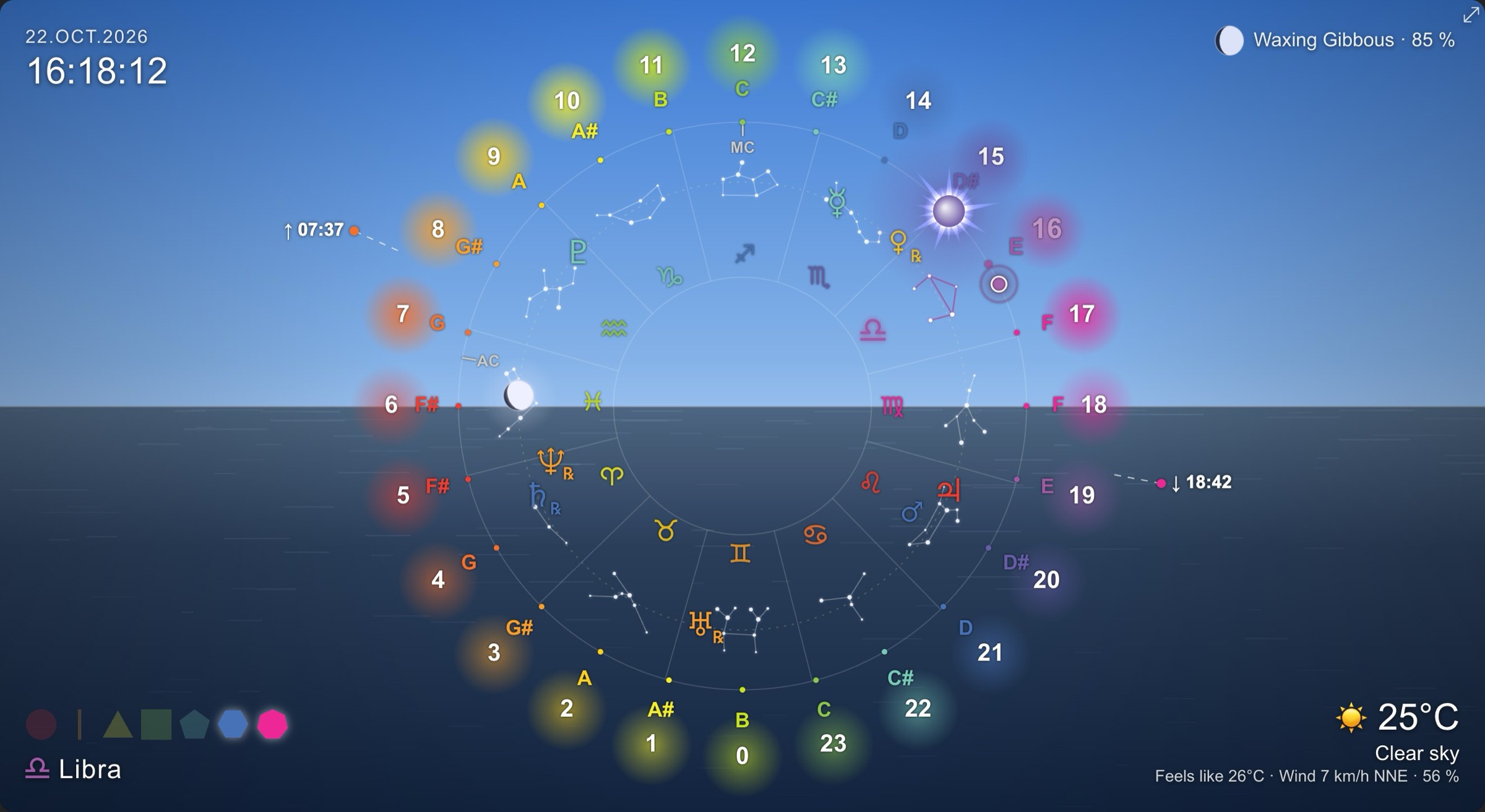
The Icosmo Sky Clock has no clock face. The whole sky is the clock: the Sun stands at the true solar time of your place, the zodiac turns like the real sky, and the Moon and the planets stand at the places where they really are right now. The current hour of your clock lights up beside it, so you see at a glance how far the clock lies from the Sun. Every hour shows its colour and its key of the Icosmo Matrix, and the sky above you brings its own weather into the picture: clouds, rain, snow, fog and thunderstorms.
The clock reads the time and the location of your device. Allow your browser to use your location, and the sunrise, the sunset, the Ascendant and the weather are calculated for the place where you are.
Fullscreen: Click the small arrow ⤢ in the top right corner to see the sky on the whole screen. Click it again to return to this page.
How to Read the Sky
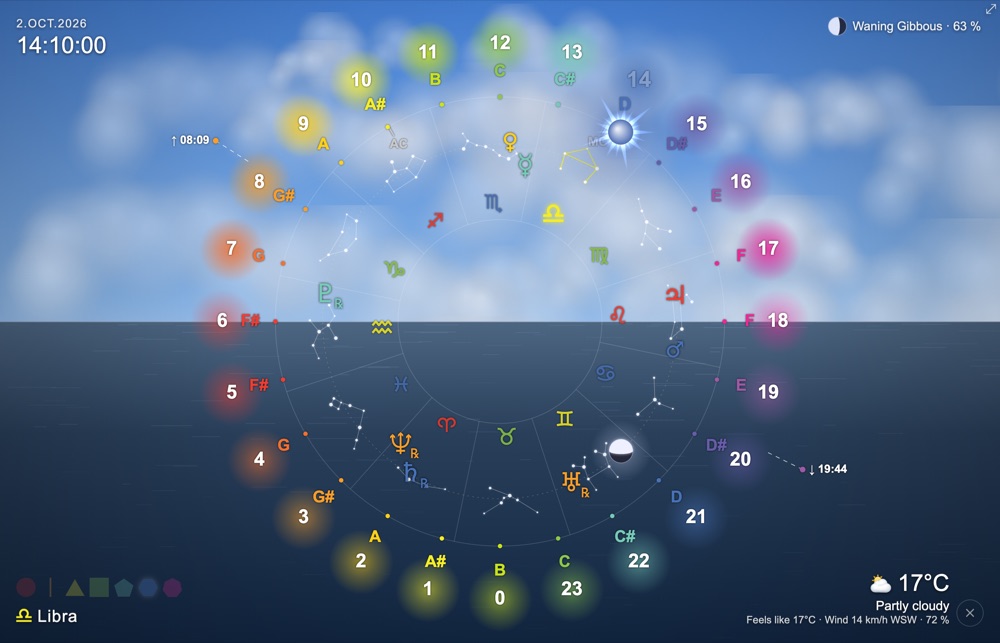
The clock runs through all 24 hours of the day. Midnight is at the bottom, 6 o’clock on the left, noon at the top and 18 o’clock on the right. The horizontal line through the centre is the horizon: above it the real sky of the moment, below it the sea, which mirrors the sky.
The Sun and the True Solar Time:
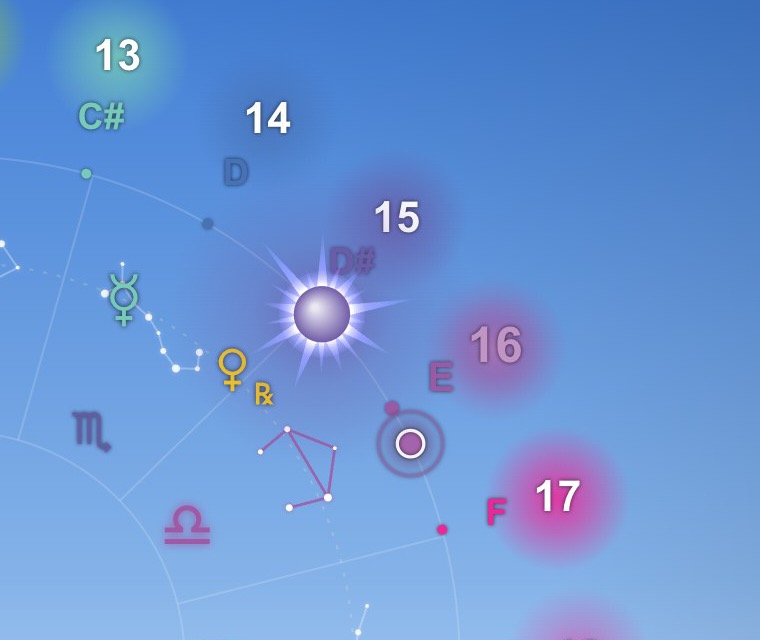
The Sun stands at its true position on the circle of the hour dots and so shows the true solar time of your place: exactly at the top at true noon. True solar time is calculated from the Sun’s hour angle and differs from the clock by the position of your place within its time zone, by daylight saving time and by the season (the equation of time, up to about 16 minutes). The Sun shines in the colour of its true solar hour of the Icosmo Matrix and blends slowly into the colour of the next hour. Around sunrise it glows red, around sunset red-violet.
The Clock Time:
The hour of your clock lights up and pulses softly, and a small dot in the colour of the hour moves along the circle of the hour dots. The distance between this dot and the Sun is the difference between your clock and the Sun – in summer often more than an hour.
While the Sun is above your real horizon, it shines with its full corona and moving rays. At night it stays visible as a calmer Sun with softer rays, so the hour is always easy to find.
Hours, Colours and Keys:
Each of the 24 hours stands in a soft glow of its Matrix colour, so the colour zones of the day can be seen around the whole sky. Above the horizon the glows grow stronger with the light of the day, so they stay visible on the blue sky, and soften again at night. Below each hour, in the inner ring, stands the key of the hour in its colour: from F# at 5 and 6 o’clock in the morning through C at noon to F at 17 and 18 o’clock, and back again through the night. The dot of the current hour is larger.
Sunrise and Sunset:
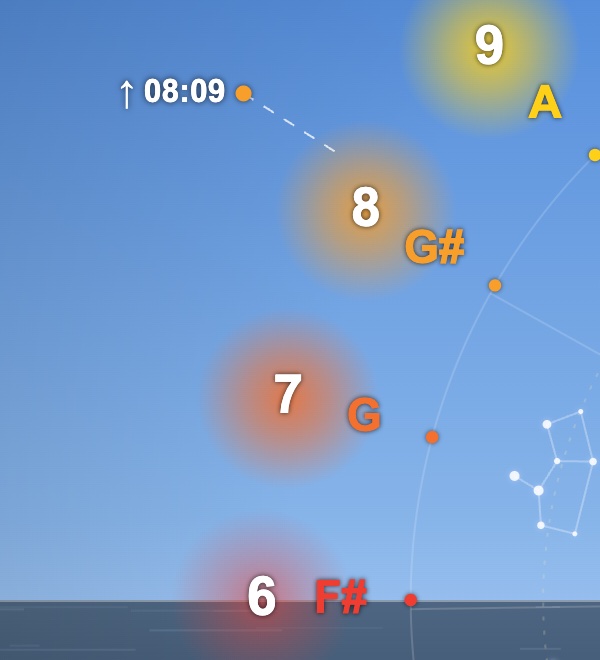
Two short dashed lines just outside the hour numbers mark the real sunrise ↑ and sunset ↓ of the day at your location, with their times. Their dots take the colour of the hour in which the Sun rises or sets. Through the year the two lines wander: in summer they move towards the night, in winter towards noon.
The Real Sky and the Sea
The sky above the horizon is your sky right now, calculated from the real height of the Sun at your location. Before sunrise the night turns into a deep blue twilight, at sunrise a reddish glow lies along the whole horizon, during the day the sky is fully blue, and at sunset it glows red-violet before the night returns. The stars appear only when it is really dark, and clouds and fog hide them.
Below the horizon lies the sea. It mirrors the colours of the sky in a darker tone, with faint glints of light on the water — blue by day, reddish at sunrise, red-violet at sunset and dark at night.
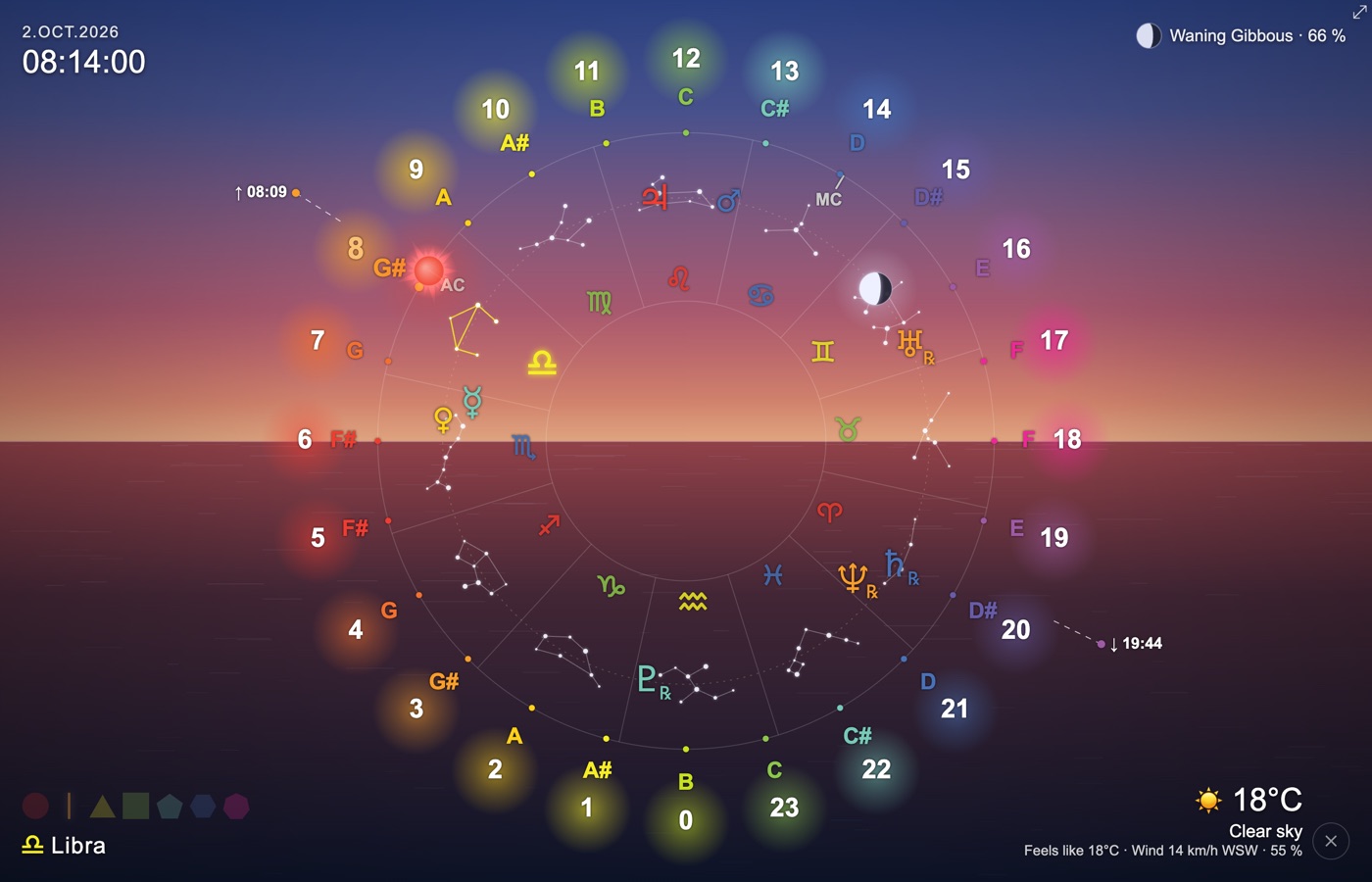
Sunrise
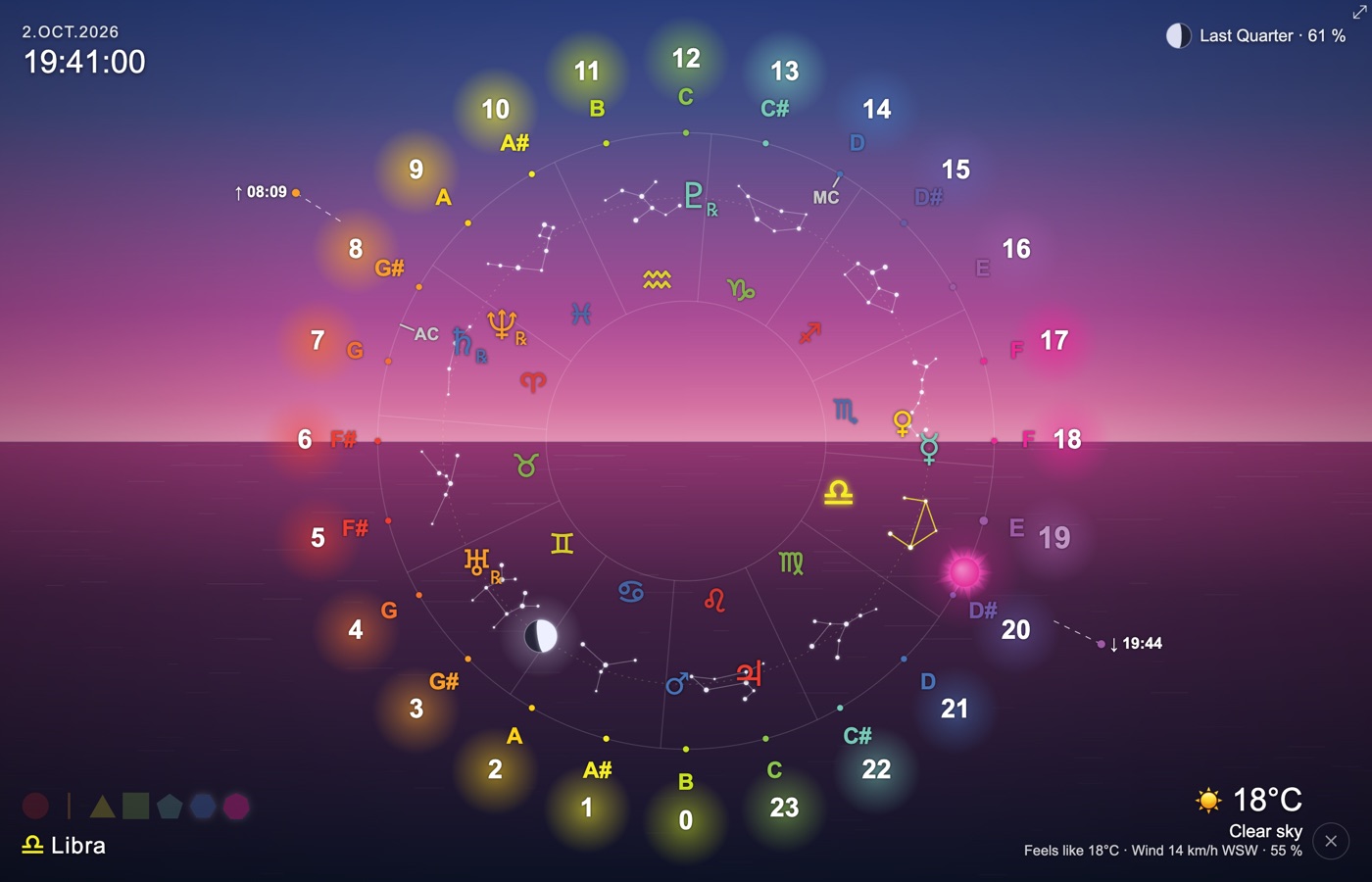
Sunset
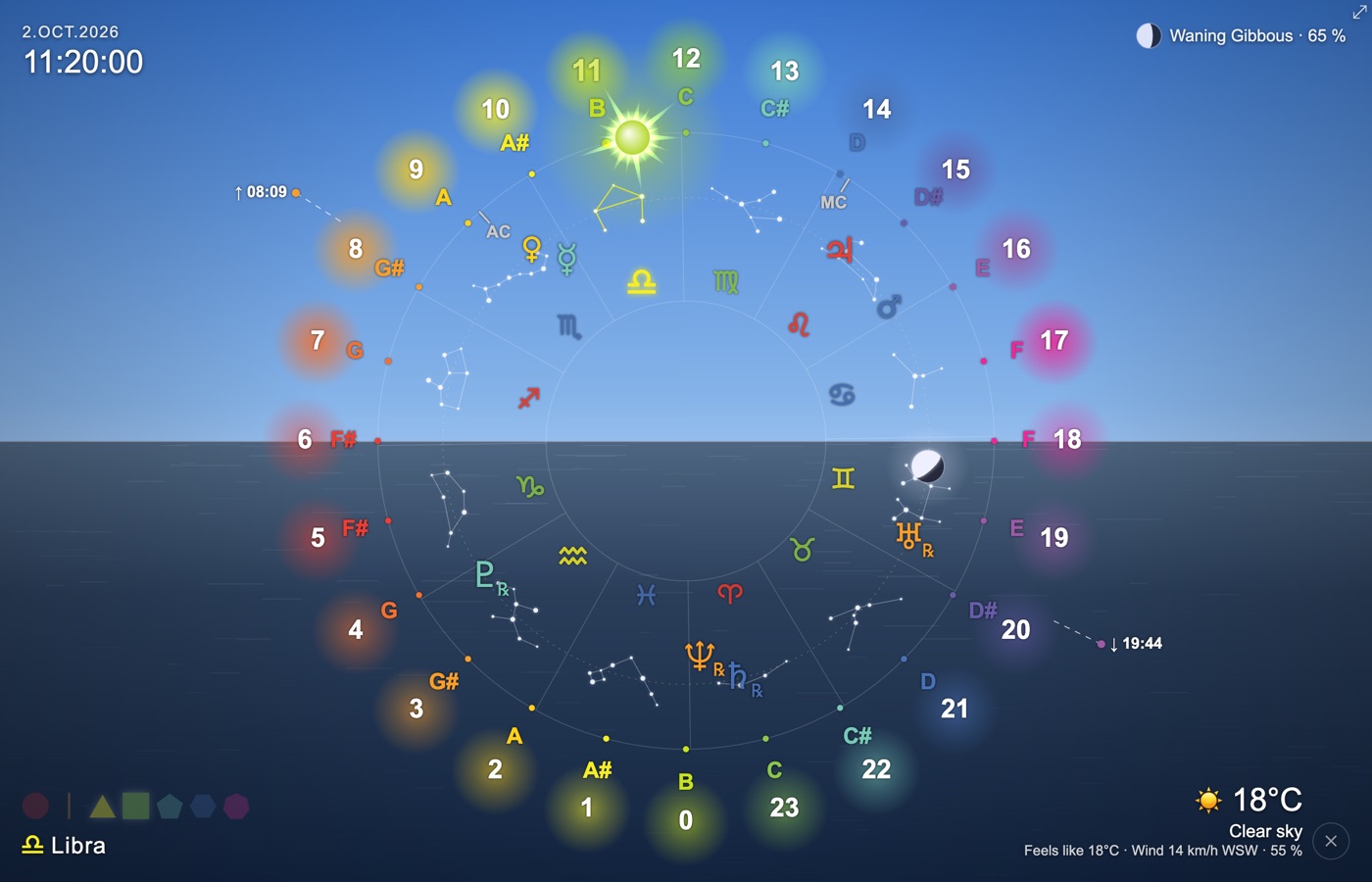
Day
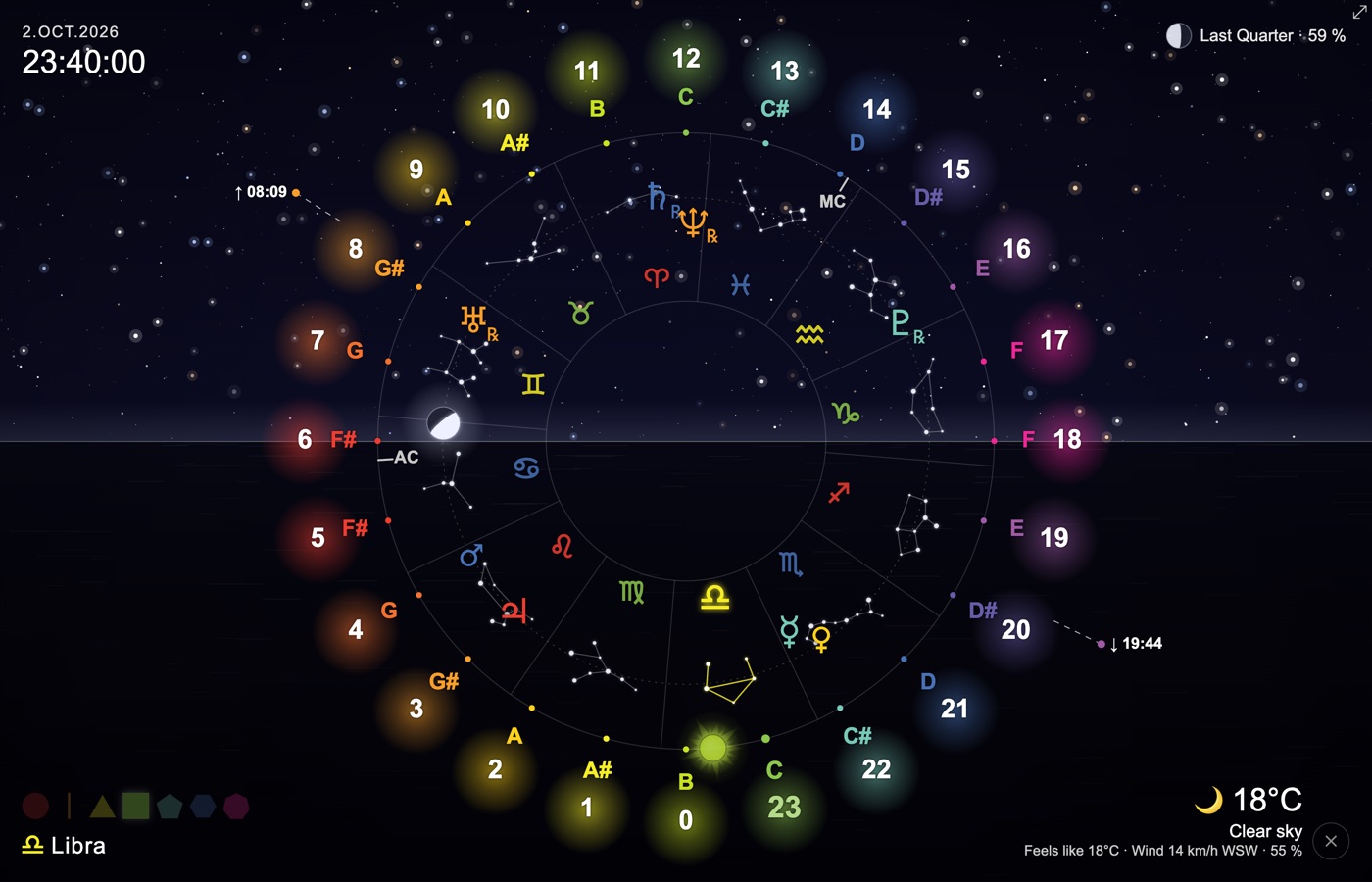
Night
The Zodiac, the Planets and the Moon
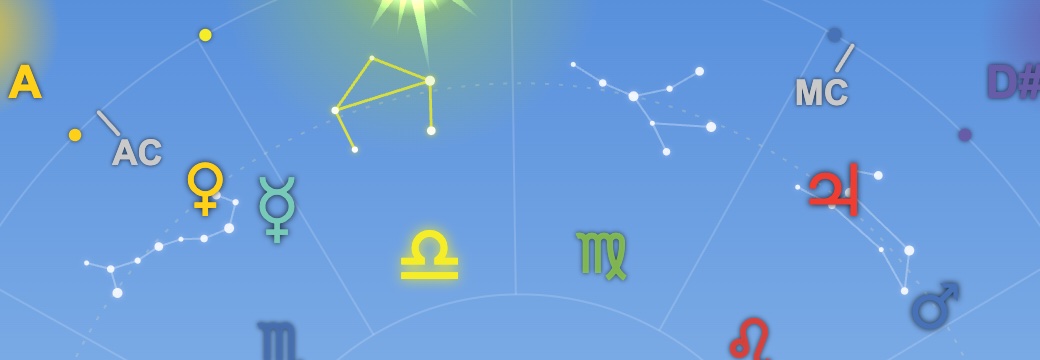
The Zodiac:
Inside the circle of the hour dots lie the twelve houses of the zodiac. Each shows the star figure of its constellation and the symbol of its sign in the colour of its element. The zodiac is turned like the real sky, with the Midheaven of your place at the top, and turns once a day with it, so the Sun always stands in its real sign; the sign of the Sun is highlighted.
The Ecliptic:
The dotted circle through the star figures is the ecliptic, the path of the Sun, the Moon and the planets through the signs. Everything that moves through the zodiac moves on this line, so you can see at a glance in which sign each planet stands.
Ascendant and Midheaven:
The marks AC and MC on the outer circle of the zodiac show the Ascendant, the degree of the zodiac rising at your horizon, and the Midheaven, the degree at the highest point of the sky, for your location and the current time.
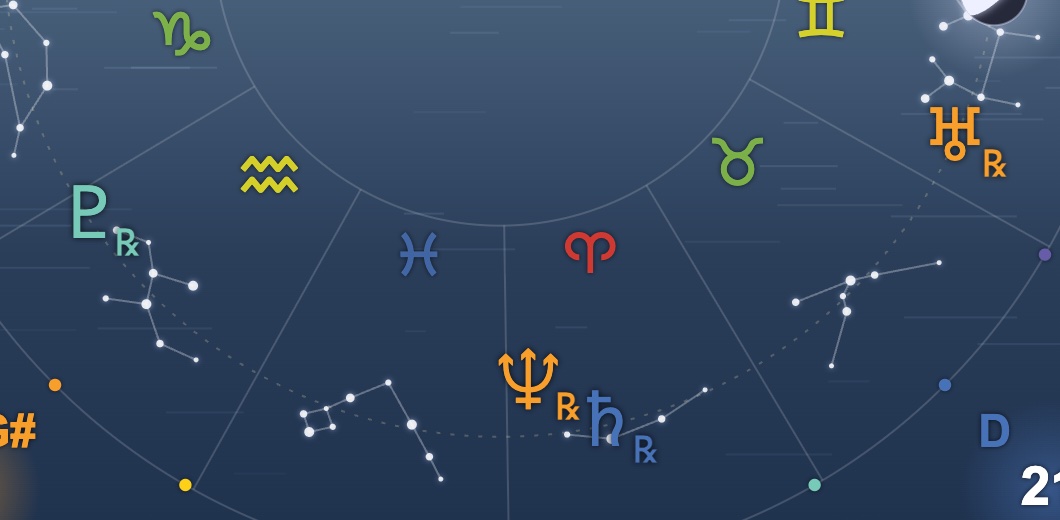
The Planets:
Mercury, Venus, Mars, Jupiter, Saturn, Uranus, Neptune and Pluto stand at their real positions on the ecliptic, each in its colour of the Icosmo Matrix. Their positions are calculated with the Swiss Ephemeris, the same astronomical calculation as in the astro charts of the Icosmo plugins, and they are updated every minute. When planets stand close together, one of them moves just inside or outside the ecliptic, so that all symbols stay readable.
Retrograde:
A small ℞ beside a planet shows that it is retrograde: seen from the Earth, it is moving backwards through the zodiac.
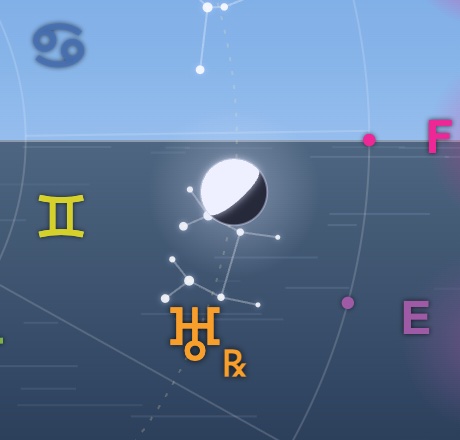
The Moon:
The Moon moves on the ecliptic through the signs and shows its real phase. In the clock its lit side always faces the Sun, as it does in the sky, so you can watch how the light turns while the Moon travels around the zodiac.
The Moon Phase:
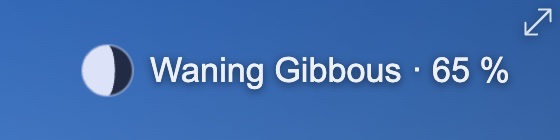
In the top right corner the Moon is shown upright, the way you see it in the sky, together with the name of its phase and how much of it is lit. In the northern hemisphere a waxing Moon is lit on the right and a waning Moon on the left; in the southern hemisphere it is the other way round.
The Corners
Date and Time (top left): the date and the time of your device.
Moon Phase (top right): the upright Moon with its phase, beside the fullscreen button.
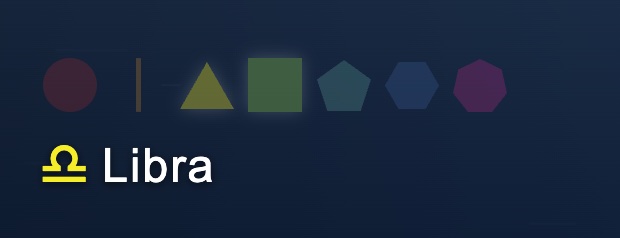
Chakras and Sign (bottom left): the seven chakras, with the chakras of the current hour lit, and below them the sign of the Sun.
The chakras follow the traffic light of the Icosmo Matrix: on the exact colour of a chakra, only this chakra is active — Root on Red, Sacral on Orange, Solar Plexus on Yellow, Heart on Green, Throat on Green-Blue, Third Eye on Blue and Crown on Red-Violet. In the hours between two chakra colours, such as Red-Orange or Yellow-Green, both neighbouring chakras are active. So there is never an hour without a chakra.
Weather (bottom right): the current weather at your location with the temperature, the conditions, the felt temperature, the wind with its direction and the humidity. The units are chosen by your location: °F and mph in the USA, °C and km/h everywhere else.
The Weather in the Sky
The sky shows the real weather at your location, updated every 15 minutes. The clouds drift with the real wind, and the amount of clouds follows the cloud cover. By day the clouds are white, at night dark, and in a storm grey. Rain, snow and hail fall down into the sea. The hours, the zodiac and the planets always stay readable above the weather.
Partly cloudy
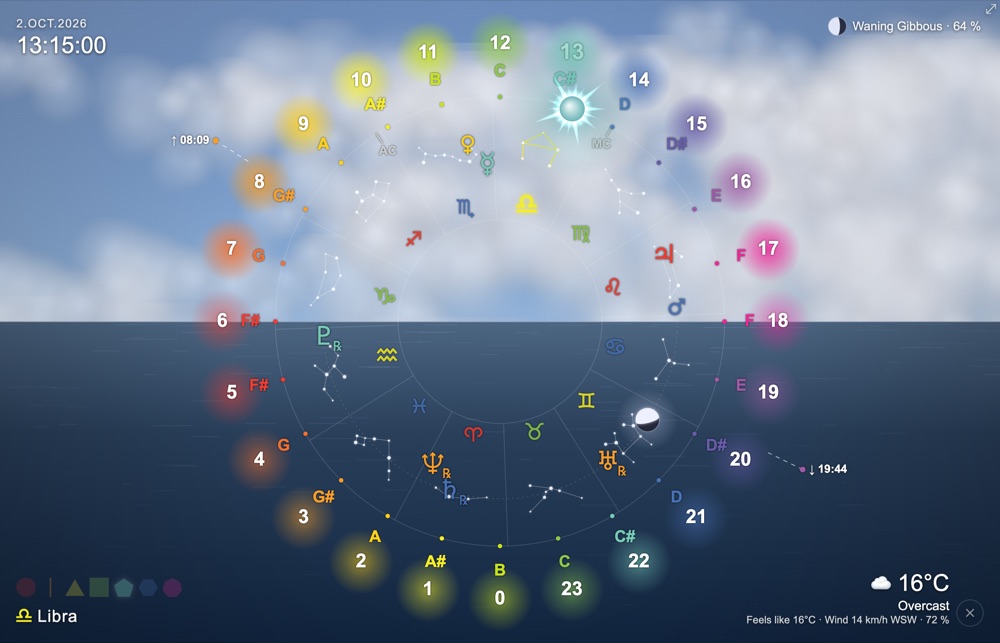
Overcast
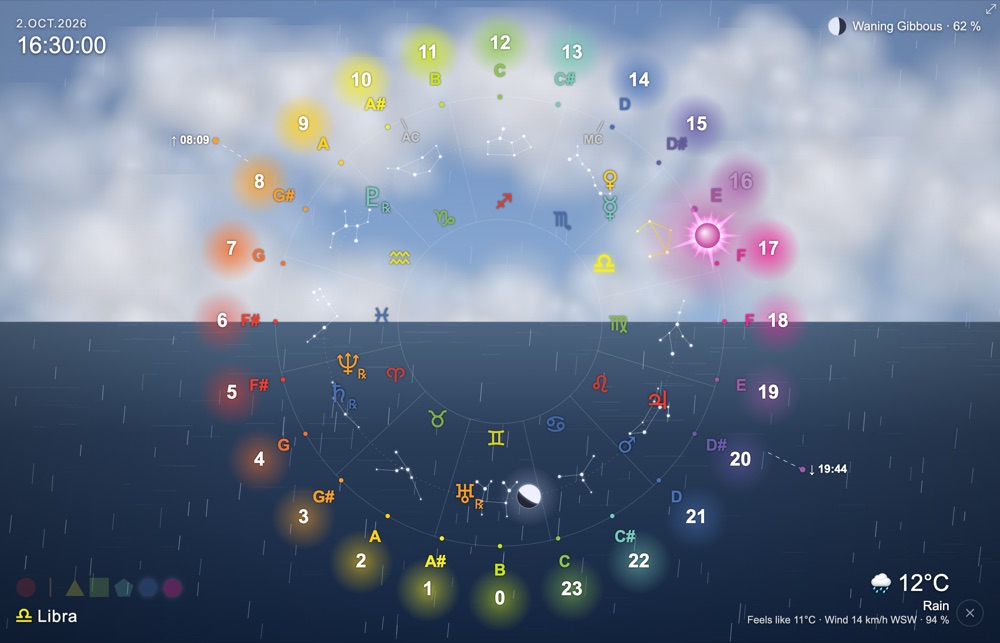
Rain
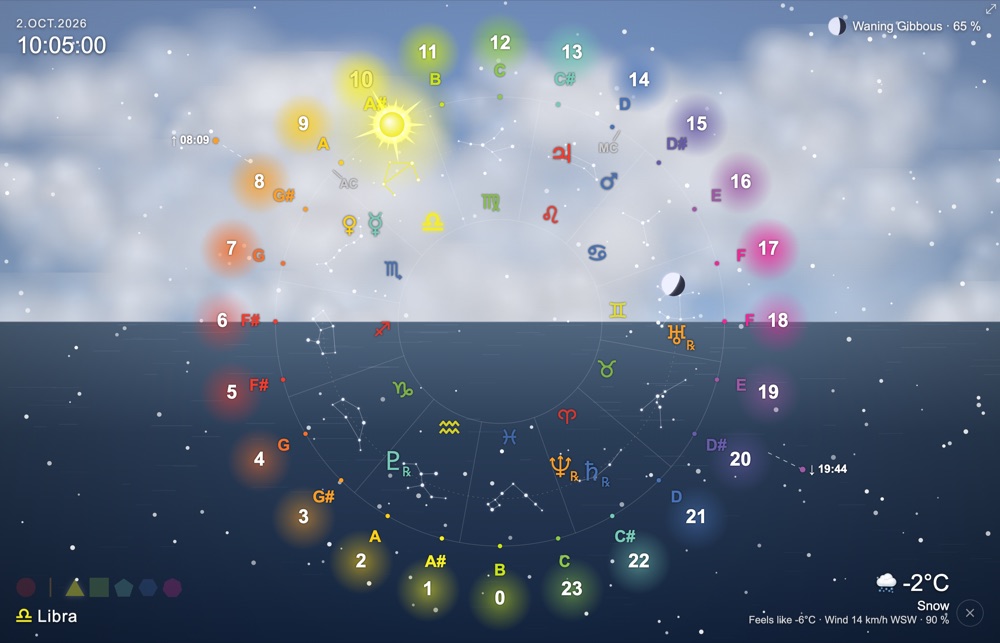
Snow
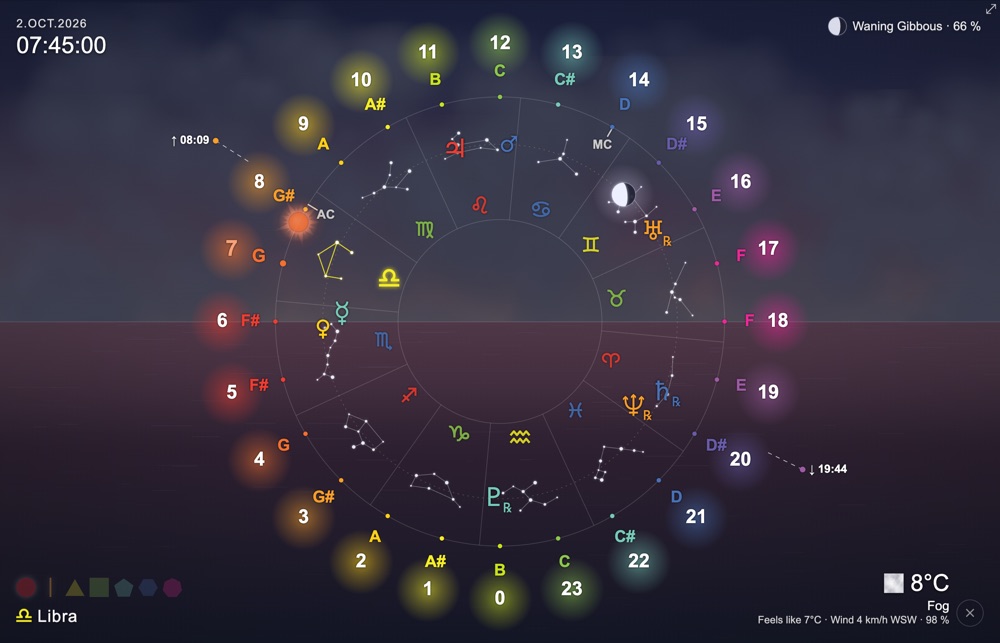
Fog
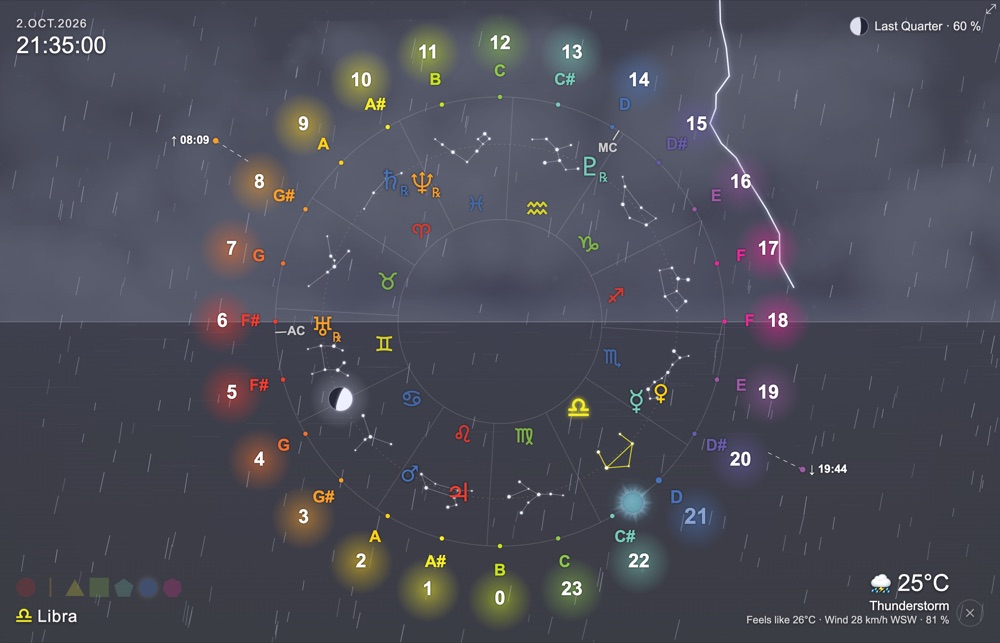
Thunderstorm
Drizzle, freezing rain, hail and snow grains have their own look as well, and lightning flashes through the sky every few seconds during a thunderstorm.
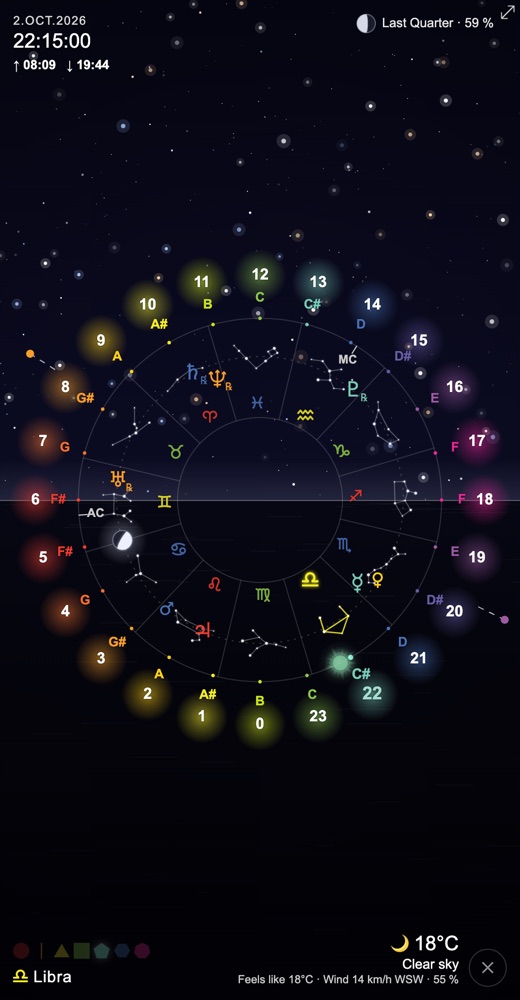
On Every Screen:
The Sky Clock fits itself to every screen. On a narrow screen held upright, such as a phone, the clock fills the width and the sky and the sea fill the space above and below it. The times of sunrise and sunset then appear below the clock time in the top left corner.
Good to Know
- Location: The clock uses the location of your device only to calculate the sunrise, the sunset, the Ascendant and the weather. Without your location, it uses Berlin for the sky and shows no weather.
- Weather: The weather data comes from Open-Meteo. Our server requests it for your location rounded to about 10 km, so your device does not connect to the weather service itself.
- The sky in the clock: The dial of the sky is turned so that the Midheaven, the meridian of your place, stands at the top. The hours around it are the hours of the clock; the Sun, the zodiac and the planets show the real sky, so the position of the Sun on the dial is the true solar time. The zodiac is spread evenly, 15° for every hour; in the real sky the signs rise at different speeds, so the Ascendant meets the sunrise line exactly only around sunrise. The positions of all signs, planets and points in the zodiac are exact.