Cosmic Octave Calculator
Welcome to the Cosmic Octave Calculator, a powerful tool inspired by the groundbreaking work of Swiss mathematician Hans Cousto. This calculator bridges the worlds of astronomy, music, and color science by transforming any time period, frequency, or wavelength into precise musical tuning data, octave-analog brainwave frequencies, and vibrant color wavelengths complete with HEX, RGB, and CMYK codes. Whether you’re exploring planetary orbits, esoteric frequencies, or light spectra, this tool reveals the hidden harmonies of the universe—turning raw cosmic data into audible tones, rhythmic tempos, and visual palettes.
For a deeper dive into the history and mathematical foundations of the Cosmic Octave, visit Planetware.de. Note: While this tool draws on esoteric concepts like solfège frequencies (e.g., the Schumann Resonance at ~7.83 Hz), claims about their therapeutic effects are not scientifically substantiated. Our focus is on the musical theory, harmonics, and resonance that make these calculations fascinating. See Schumann Resonances on Wikipedia and Solfège for more.
Created by Konstantin Jagoulis on March 1, 2024, in Crete. Updated November 28, 2025, with enhanced brainwave analysis.
How the Calculator Works
The Cosmic Octave Calculator processes your input through a simple yet profound workflow:
- Enter Your Input: Choose one of three methods to start—time periods (e.g., a planet’s orbit), direct frequencies (e.g., a healing tone), or wavelengths (e.g., a color’s light spectrum).
- Conversion to Core Frequency: All inputs are normalized to seconds, then inverted to yield the orbital frequency (f = 1 / seconds).
- Octave Adjustment: The frequency is iteratively multiplied or divided by 2 (octaves) until it lands in the audible human hearing range (approximately 127–508 Hz, based on Cousto’s planetary tuning scale).
- Derived Outputs: From this tone frequency, the tool generates:
- Musical elements: Note name, pitch deviation, master tuning, tempo (BPM), and delay time (ms).
- Visual elements: Equivalent wavelength in the visible light spectrum (380–780 nm), color name, and color codes.
- Brainwave elements: Octave-reduced versions of the tone frequency mapped to standard brainwave bands (Delta, Alpha, Beta, Gamma) for insights into potential neural resonances.
- Audio Playback: The tone frequency loads automatically into the integrated synth player for immediate listening.
- Results Display: Outputs populate interactive tables for easy reading.
Press Convert after entering data, or use Reset to clear forms. A Master Clear button resets everything.
Input Methods
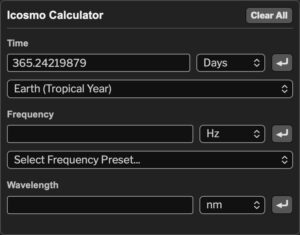
Time Period (Orbital Periods)
- What to Enter: Any duration, like Earth’s year (1 year) or a moon’s orbit.
- Units: Years, days, hours, minutes, or seconds.
- Presets: Quick-select from a dropdown of Solar System bodies, including:
- Sun rotation frequencies.
- Planets (Mercury to Neptune, plus dwarf planet Pluto).
- Earth’s sidereal day and year.
- Lunar cycles (e.g., synodic month).
- Moons of Jupiter (e.g., Io), Saturn (e.g., Titan), Uranus, and Neptune.
- Example: Enter “1” in Years → Calculates Earth’s orbital frequency (~3.17 × 10⁻⁸ Hz), octavized to a tone of ~194.18 Hz (near F#).
Frequency
- What to Enter: Any value, from sub-Hz cosmic signals to THz light waves.
- Units: Hz, kHz, MHz, GHz, THz.
- Presets: Popular esoteric frequencies (e.g., 432 Hz, 528 Hz) for quick musical exploration.
- Example: Enter “7.83” Hz (Schumann Resonance) → Octavizes to ~126.22 Hz (near B).
Wavelength
- What to Enter: Any length, auto-converted to nanometers for visible light.
- Units: nm (nanometers), µm, mm, cm, m, km.
- Example: Enter “500” nm (green light) → Yields frequency ~599.58 THz, octavized to ~189.10 Hz (near F).
The Integrated Audio Player & Metronome
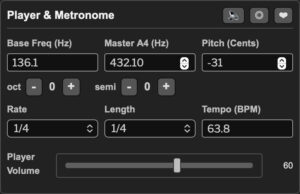
Once calculated, the tone frequency auto-loads into the synth player, letting you hear the cosmic harmony instantly. This is a simple sinusoidal waveform oscillator for pure tone playback—no complex synth patches, just the essence of the frequency.
Player Controls
- Frequency Input: Shows the calculated tone (editable in Hz).
- Octave +/-: Shift up/down by full octaves (×2 or ÷2) to explore harmonics.
- Half-Step +/-: Nudge in semitones along the 12-note chromatic scale for fine-tuning.
- Play/Stop: Toggle playback. Listen in real-time to feel the vibration.
Metronome (Rhythmic Layer)
Enhance your listening with a programmable metronome tied to the calculated tempo:
- Loop Length: 1–16 bars (repeats the cycle).
- Tone Length: Full bar, 1/2, 1/4, 1/8, or 1/16 note (plays a click at the start of the first bar).
- Tempo (BPM): Auto-fills from the calculator (editable).
- Start/Stop: Launch the loop—perfect for meditation, composition, or rhythm entrainment.
Pro Tip: Pair a planetary tone (e.g., Earth’s 194 Hz) with its calculated BPM (~90) for a session that aligns body and cosmos.
Reading the Results: Output Panels
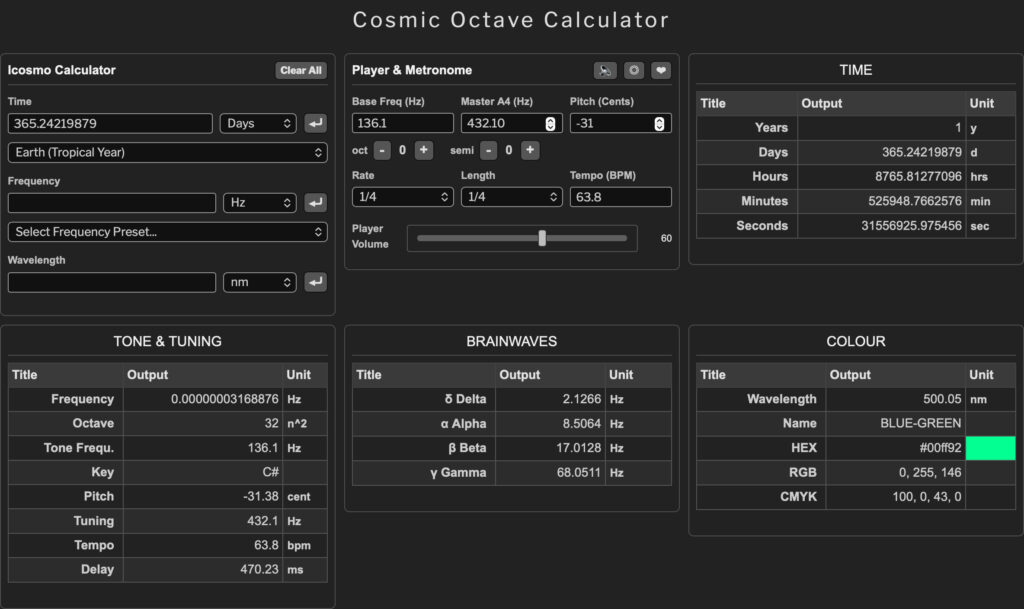
Results appear in four dynamic tables, updating instantly. Each row shows a title (what it measures), output value, and unit. Tables are grouped for clarity: Time, Tone & Tuning, Colour Data, and the new Brainwaves panel.
Time Data Panel
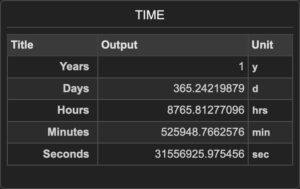
Converts your input across scales—useful for verifying cosmic periods.
- Years (y): Input in Earth years.
- Days (d): Solar days.
- Hours (hrs): Clock hours.
- Minutes (min): Minutes.
- Seconds (sec): Total seconds (base for calculations).
- Example: 1 year → 365.25 days, 8,766 hrs, etc., down to 31,556,925.9747 sec.
Tone & Tuning Panel
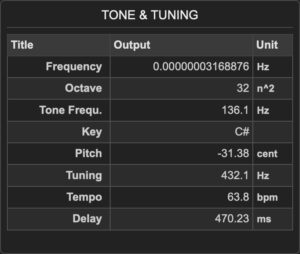
The musical heart—maps your input to playable sound.
- Frequency (Hz): Raw orbital frequency (f = 1/sec; very small for long periods).
- Octave (n²): Number of octave shifts (±) to reach audible range.
- Tone Frequ. (Hz): Final audible frequency (e.g., 194.18 Hz).
- Key: Musical note (e.g., F#, from the 12-tone scale).
- Pitch (cent): Detuning in cents from A=440 Hz (0 = perfect match; positive/negative = sharp/flat).
- Tuning (Hz): Master reference frequency (e.g., 432 Hz for alternate tunings).
- Tempo (bpm): Octave-derived beats per minute (tone × 60 / 128).
- Delay (ms): Echo delay for rhythmic effects (60 / tempo × 4 / 8 × 1000).
- Example: Earth’s tone (194.18 Hz) → Key: F#, Pitch: -31.77 cents, Tuning: 194.18 Hz, Tempo: 90.85 bpm, Delay: 331.20 ms.
Colour Data Panel
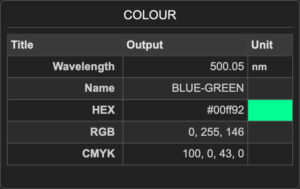
Translates sound to sight—wavelengths in the visible spectrum (380–780 nm). Color codes are approximations for artistic use.
- Wavelength (nm): Octave-adjusted light wavelength.
- Name: Color label (e.g., GREEN, BLUE-GREEN).
- HEX: Web color code (e.g., #00FF00).
- RGB: Red-Green-Blue values (e.g., 0, 255, 0).
- CMYK: Cyan-Magenta-Yellow-Key for print (e.g., 100, 0, 100, 0).
- Visual Preview: HEX and RGB rows show colored backgrounds for instant vibe check.
- Example: 194.18 Hz tone → 555.00 nm → GREEN (#8CC74B, RGB: 140, 199, 75).
Brainwaves Panel (New in 2025 Update!)
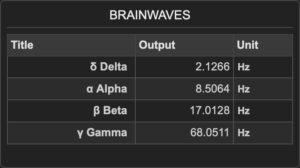
Explore neural resonances: The tone frequency is octave-reduced (÷2 repeatedly) to fit standard brainwave bands. If no exact match after 100 iterations, it shows “no match.” Symbols (δ, α, β, γ) add a nod to EEG science.
- Delta (δ) Hz: Deep sleep/dreamless (0.5–4 Hz). E.g., 194.18 Hz → 3.03 Hz (÷2 five times).
- Alpha (α) Hz: Relaxed awareness (8–12 Hz). E.g., 12.12 Hz.
- Beta (β) Hz: Active thinking (12–30 Hz). E.g., 24.25 Hz.
- Gamma (γ) Hz: High cognition (30–100 Hz). E.g., 48.50 Hz.
- How to Read: Values indicate the closest octave-fit frequency. Use for meditation (e.g., Alpha for calm) or biofeedback ideas. No match? Try a different input—most tones hit 3–4 bands.
- Example: 136.1 Hz (Heart Chakra tone) → Gamma: 68.05 Hz (÷2 once), Beta: 17.01 Hz, Alpha: 8.51 Hz (no Delta match).
Get Started
- Pick an input tab (Time, Frequency, Wavelength).
- Enter a value or select a preset.
- Hit Convert—watch the magic unfold.
- Play the tone and explore octaves.
- Dive into the tables for data, then create: Compose music, design palettes, or meditate on brainwaves.
Technical Note: Color conversions are artistic approximations. For extreme values (e.g., cosmic timescales), results clamp to safe ranges. Questions? Contact info@icosmo.de.
Unlock the universe’s symphony—calculate, listen, and create today!
KONSTANTIN JAGOULIS
28th of November 2025
Chania, Greece